
teaching myself how to write: a syllabus
DIY MFA, part 1

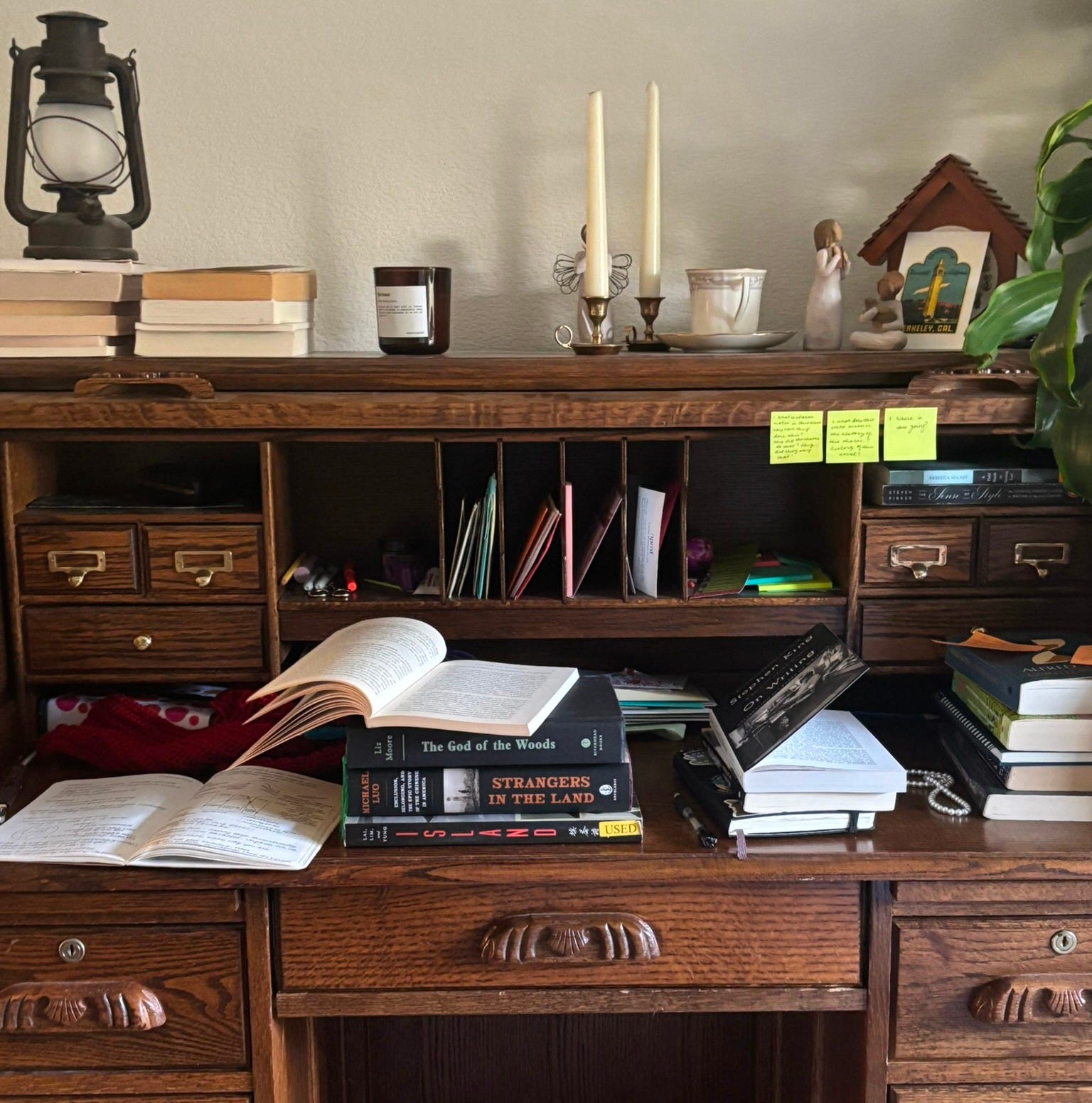
I have always written, though I’ve never considered myself a writer. This is not out of self deprecation, but because I did not actually know how to write—at least not well. I could certainly string sentences together and recognize a good turn of phrase or plot structure, but I couldn’t articulate to you how to actually craft a good novel or story, or explain what the elements of a good narrative were.
I fell in love with stories as a child before I could even read myself, and have wanted to be an author from the moment I learned that that was a possibility. As a result, I spent a large part of my childhood and teenage years writing: bad fanfiction, crummy poetry, half-baked short stories. After a couple of decades of blissful vibes-based writing, I decided that it was finally time to change that at the start of this year. I wanted to actualize this desire of mine—to write and to see my writing exist outside of myself in some official capacity. I wanted to learn, and to take what I learned and make something out of it.
I’ve been lucky enough that here in Houston, Inprint offers writing workshops and classes for adults, both in person and online. I was able to take a couple of them earlier this year, and they’ve helped me tremendously. Learning from an instructor in-person and receiving peer feedback on your work is invaluable, and I’d highly recommend it to anyone who is serious about improving their craft (if it’s an accessible option). There are plenty of places online that offer writing classes and workshops as well.
That being said, a lot of my own learning process has involved seeking out resources for myself. I’ve been talking to writer friends, scouring bookstores, and consulting the mystical oracle that is the Internet. I’m still new to all of this, of course, but here is what I’ve found to be most helpful in the past year as a beginner writer, without bogging you down with the overwhelming number of resources that are out there. I hope it helps you on your journey too!1
Introduction to Creative Writing
⟡☕︎⟡☕︎⟡
READING LIST
Note: You do NOT need to buy all (or any) of the following books listed. These are simply some suggestions. If you do decide to get them, be sure to borrow from your public library, or buy them from an indie or used bookstore. If you purchase using my BookShop affiliate links below, I will earn a commission.
Memoirs/Essays:
These are mainly for inspiration and motivation. I read a few pages from one of these at the start of each of my writing sessions.
Body Work by Melissa Febos
This was the first memoir/craft book I ever read, back when I hadn’t even begun to consider writing something (seriously) myself—least of all anything personal. Body Work was the first thing that made me feel like I might have something worthwhile to say/create/share. It focuses on personal essays/memoirs, but I think the encouragements apply more widely.
Bird by Bird: Some Instructions on Writing and Life by Anne Lamott
This was (intentionally) my first read of the year. A tender and dazzlingly funny book. So wonderful for reminding myself to slow down, be patient, and take writing (and life) one step at a time. And maybe most importantly, to delight in the process itself rather than getting lost in the fantasy of publication. To write because I must. Because it is what I was put on earth to do. Because I love writing. Lamott brought me back, again and again, to that core truth.
Novelist as a Vocation by Haruki Murakami
Murakami has long been one of my favorite authors and I’m particularly fond of his nonfiction (though there are so few). Novelist as an assemblage of essays and lectures on the title topic, gathering his many years of writing experience. While not super tangibly practical, his insights are inspirational at times and offer a wonderful peek into the daily life of such a prolific writer.
I plan to read the following books next:
Writing Down the Bones: Freeing the Writer Within by Natalie Goldberg
On Writing: A Memoir of the Craft by Stephen King
Steering the Craft: A 21st Century Guide to Sailing the Sea of Story by Ursula K. Le Guin
Writing Toolbox:
These will become your beginner writer bibles. Useful as references, no matter where you are in the process.
Save the Cat! Writes a Novel by Jessica Brody
A great resource for learning the basic “beats” that make up a novel. Helpful for when you’re just starting out and need a general template to go off of. After learning the Save the Cat structure, you’ll start noticing that so many movies/novels actually follow this template!
I bought a copy of Save the Cat! Writes Horror (by Jamie Nash)—which just came out last month—for some tailored advice.
Writing Fiction: A Guide to Narrative Craft by Janet Burroway
Recommended by a writer friend, whose debut novel is coming out next year. It teaches you the different parts that make up a book: characters, plot, POV, etc. Also includes writing exercises at the end of each chapter. Incredible for pure beginners, like me.
Refuse to be Done: How to Write and Rewrite a Novel in Three Drafts by Matt Bell
Recommended by the same friend as above. The first chapter (on the first draft) has been helpful for generating new ideas and for moments when I get stuck. The later chapters delve into the revision and finalization process.
The Elements of Style by E.B. White and William Strunk, Jr.
A solid style guide. As with everything, learn it, then break the rules with intention if it pleases you. I own the illustrated edition by Maira Kalman!
The Emotion Thesaurus: The Writer’s Guide to Character Expression by Angela Ackerman and Becca Puglisi
Good for brainstorming different ways to show your characters’ emotions (body language, expressions, thoughts). I don’t rely on this one too much, but it’s helpful when you’re really stuck!
⟡⟡⟡
I won’t prescribe you with a particular order or way to read these books. However, my small suggestion would be to first understand the Save the Cat structure (and/or whatever other plot structures you want, such as Freytag’s pyramid) and begin to read through Writing Fiction, paying attention to the chapters on plot, POV, and characterization. Then, dive into whatever writing project you want, be it a novel or short story. As you write and inevitably come across various obstacles (writer’s block, confusion over characters/setting/imagery/etc.), refer back to the books in your toolbox as needed, and read the memoir and craft books for inspiration and as morale boosters. Finally, read widely—not just craft books! You cannot be a good writer without being an avid reader. I stand by this, as do many other much more accomplished and seasoned writers. As William Faulkner said,
Read, read, read. Read everything—trash, classics, good and bad, and see how they do it. Just like a carpenter who works as an apprentice and studies the master. Read! You’ll absorb it. Then write. If it is good, you’ll find out. If it’s not, throw it out the window.
⟡⟡⟡
FINAL PROJECT
Complete a novel
Yours can be something different! Here are some other suggestions:
Write and revise a short story. Submit it to ten (or more) literary journals and magazines.
Write and revise a personal essay. Post it on Substack.
Complete one writing exercise a day for a month.
Given the long-haul nature of the final project, I’m not offering any deadlines. This will be up to you and your individual writing project. As a rough guideline however—and to keep myself accountable—I am planning to have a completed first draft within a year from now. Revisions will take however long they take.
If you have any craft book suggestions, let me know! I’d also love to hear about your projects.
Good luck and happy writing!
⟡☕︎⟡☕︎⟡
With all that being said, here’s a reminder that I am very much so a beginner! Maybe someday when I am a bit further down the line, I’ll post an updated version of this syllabus.
I love this! Thanks for sharing. As an editor, I will say The Elements of Style is outdated and even inaccurate; it gets some things completely wrong (like, its description of passive voice is wrong). If you’re curious about style, or punctuation and grammar, you can buy a monthly online subscription to The Chicago Manual of Style (the online version is cheaper and has a helpful search function), which is the publishing industry’s standard style guide, then you can cancel the sub when you’ve taken all your notes or screenshots lol.
This is so good, thank you!! I’ve always been a bit sceptical of writing guides, but I read Steering the Craft recently and it was really enjoyable. It taught me to look at things like POV in a much more mature way. Can’t wait to pick up some of these!